
Thursday, February 23, 2017
The Cronicle of Alfonso X
The Estoria de Espanna Digital project is an electronic research environment and searchable digital edition of the chronicle of Alfonso X, king of Castile and Leon. Aengus Ward, University of Birmingham, UK, has assembled a team of scholars to bring together the rich manuscript tradition of this document in digital form.
 During the month of February 2017, several of the extant manuscripts are being exhibited by the institutions that hold them in their collections. The University of Minnesota's copy will be on display at the James Ford Bell Library through the end of the month. Following the exhibition, it may be seen in person by request at the Bell Library. The complete manuscript is also available online: Primera Cronica General de España

Wednesday, February 22, 2017
Library Cats I
I
wish we could have a library cat like other libraries do. However, we really can't risk a hairball
suddenly gracing the open pages of the first printed edition of Marco Polo's Travels (Bell Call # 1477 Po).
Hence the title of this blog: it
reflects my own cat-like curiosity about the world and its books. And although I can't cuddle up with one on a
rainy afternoon at work, cats do grace several of the pages in the Bell
Library's rare book collection. Take
this one, for instance, a medieval mouser complete with trophy.
It's a hand-drawn marginal illustration in our copy of Bartholomeus Anglicus' Le
propriétaire des choses. This late 14th-century Old French edition of the 13th-century Latin original, De proprietatibus rerum, is a marvelous example of a decorated and illuminated European book.
Bartholomeus, a Franciscan monk, compiled his master work ca. 1240; it was translated into French by Jean Corbechon in 1372.
 |
| Bell Library shelf mark: 1400 oBa |
Bartholomeus, a Franciscan monk, compiled his master work ca. 1240; it was translated into French by Jean Corbechon in 1372.
Sunday, March 06, 2016
Following Captain Cook
I was on a crowded bus heading north, my husband beside me, when the driver said "And on your right is Cook's Inlet." My mind blew up. Captain James Cook and his crew had actually sailed the Resolution into that bay--the very first Europeans to have seen it. And here I was, driving along its shore myself, a faint drizzle marring what would be a rather blurry photo. All of a sudden I was there, aboard the Resolution, awestruck by the way the land rose directly up from the sea, how the mist shrouded some but not all of ridges. I stayed in this state of suspended historical animation for the entire Alaska cruise, from Seward to Vancouver.
 We began our Alaskan adventure in Anchorage, after an easy non-stop five-hour flight. (It took us 14 hours and 4 planes to get to Acapulco last January so we already were in heaven.) The Anchorage Museum, outside of which we would pick up our bus to Seward and the cruise ship, had on exhibit a fabulous homage to Captain Cook and his third voyage: Artic Ambitions: Captain Cook and the Northwest Passage. It was brilliantly done, with original paintings, diaries, and other items on loan from Australia, England, and other places, as well as items from the museum's own collection. As a curator of rare materials who often mounts exhibitions, I was green with envy at the custom made cases and exhibit stands, the custom interpretative maps and models. My husband found it very amusing as I went around the exhibit mumbling "we have that," we have that, too," "Oooh, I wish we had that one," "Look honey, we have that at home!" The Bell Collection is super when it comes to Cook materials, but we don't have any of the original drawings or watercolors that were part of this exhibition. The image featured here is by artist John Webber: A Man of Oonalashka. From James Cook, A Voyage to the Pacific Ocean. London: G. Nicol and T. Cadell, 1785. Bell Library Call# 1785 Co You can find it and other images in our online exhibition: Captain Cook's Voyages of Discovery.
 Alaska is the most moving and beautiful place I have ever been. It was also the most surprising--from the world-class cuisine at Seward's The Cookery to the sparse population of even the largest of its few cities to the local history about which I was appalling ignorant. On March 30, 1867, the U.S. government, in the person of Secretary of
State William Seward, reached an agreement with the Russian empire to
purchase Alaska for more than $7 million. Called "Seward's Folly,"
opposition to the purchase didn't really die down until gold was
discovered in the Klondike in 1896.
Alaska is the most moving and beautiful place I have ever been. It was also the most surprising--from the world-class cuisine at Seward's The Cookery to the sparse population of even the largest of its few cities to the local history about which I was appalling ignorant. On March 30, 1867, the U.S. government, in the person of Secretary of
State William Seward, reached an agreement with the Russian empire to
purchase Alaska for more than $7 million. Called "Seward's Folly,"
opposition to the purchase didn't really die down until gold was
discovered in the Klondike in 1896.
The people of Alaska, descendants of the indigenous population and transplanted "southerners" alike, work hard to keep that history alive and to share it with visitors. Our visit to Skagway immersed us in history from the very beginning, when we boarded an old trolley car, converted to wheels, for a tour.
Our tour guide shared a variety of fun facts, history, and local sites, from the cost of a gallon of milk -- $7.00 -- to the story of the shootout between Frank H. Reid, a local businessman and city surveyor and outlaw Jefferson "Soapy" Smith in July of 1898. Control of the town was at stake. Smith shot Reid, who died of his wounds eight days later. We also saw Sarah Palin's childhood home.
I was hoping to see a lot of wildlife, but the weather often made visibility poor--if they were there, we didn't see them. We did see amazing scenery at every turn, including this and other glaciers.

Despite the distance of time, it was easy to picture Cook and his crew in every bay and along every shore.


The people of Alaska, descendants of the indigenous population and transplanted "southerners" alike, work hard to keep that history alive and to share it with visitors. Our visit to Skagway immersed us in history from the very beginning, when we boarded an old trolley car, converted to wheels, for a tour.
 |
| Our tour guide posing at Reid's tombstone. |
I was hoping to see a lot of wildlife, but the weather often made visibility poor--if they were there, we didn't see them. We did see amazing scenery at every turn, including this and other glaciers.

Despite the distance of time, it was easy to picture Cook and his crew in every bay and along every shore.
Saturday, February 27, 2016
About Polar Bears

Today is International Polar Bear Day. As far as I can tell, this is a "holiday" created and promoted by Polar Bears International, a conservation organization dedicated to the preservation of polar bears and the environment in which they live.
I've always been a fan of bears, beginning with my well-worn childhood teddy bears. I had two. A very small one I must have received as an infant that I literally hugged to pieces, and a larger one that I managed to keep intact until I was about 17. For the life of me I cannot remember their names. I know they had names because I always name my stuffed animals. My brothers started giving me teddy bears for birthdays and Christmas in my early 20s; my husband added books and I've purchased a few small bears myself, so now I have quite a collection. These furry, sometimes well-dressed, creatures live on my bookshelves. And lest you imagine a few tidy bookcases in a den or study upon which sit an equally tidy row of small stuffed bears, think again. I'm an academic. There are bookcases in the entryway, bookcases in the living room, bookcases in the large unnameable room on the other side of our kitchen bar that, while it does contain our large kitchen table, also has a desk, love seat, easy chair, end table, and exercise bike, bookcase on the landing going up to the second floor, bookcases in the bedroom, bookcases in the tv room, bookcases in my office, and a host of bookcases in the basement family room. Teddy bears can be found both upstairs and downstairs. I keep a couple of especially cuddly ones on the lower shelves of one of the family room bookcases so they are within easy reach of the great-grandchildren. They know where they are, particularly the three- and four-year olds. My fascination with teddy bears led me to the Teddy Bear Museum of Stratford-upon-Avon in England in the early 1990s. Some of this collection is now housed at the Polka Theatre in London, but there is also a Teddy Bear Museum in Dorset that has a wonderful collection, including a 1906 bear created on the original 1902 US pattern by Morris and Rose Michtom: "Teddy's Bear." Their website includes a short history of the origins of the teddy bear.

Thursday, February 18, 2016
Black History Month
Education has played an important role in this national holiday, starting with its precursor, Negro History Week, in 1926. Black History Month has been soundly criticized on a number of fronts, including the charge that it is racist and that the history of a race cannot and should not be relegated to a single month. However, in the spirit of George Santayana's (1863-1956) famous quote: "Those who do not remember the past are condemned to repeat it," Black History Month helps us to focus attention on several aspects of our history that we must not forget.

Stedman was in Suriname for five years. While there he kept a journal and several diaries, wrote letters, and made watercolor sketches of what he saw and what he felt about it. He used these observations to craft a more formalized account of his time there, which was published by the radical British printer, Joseph Johnson, in 1796, with engravings based on Stedman's watercolors by William Blake and Francesco Bartolozzi.
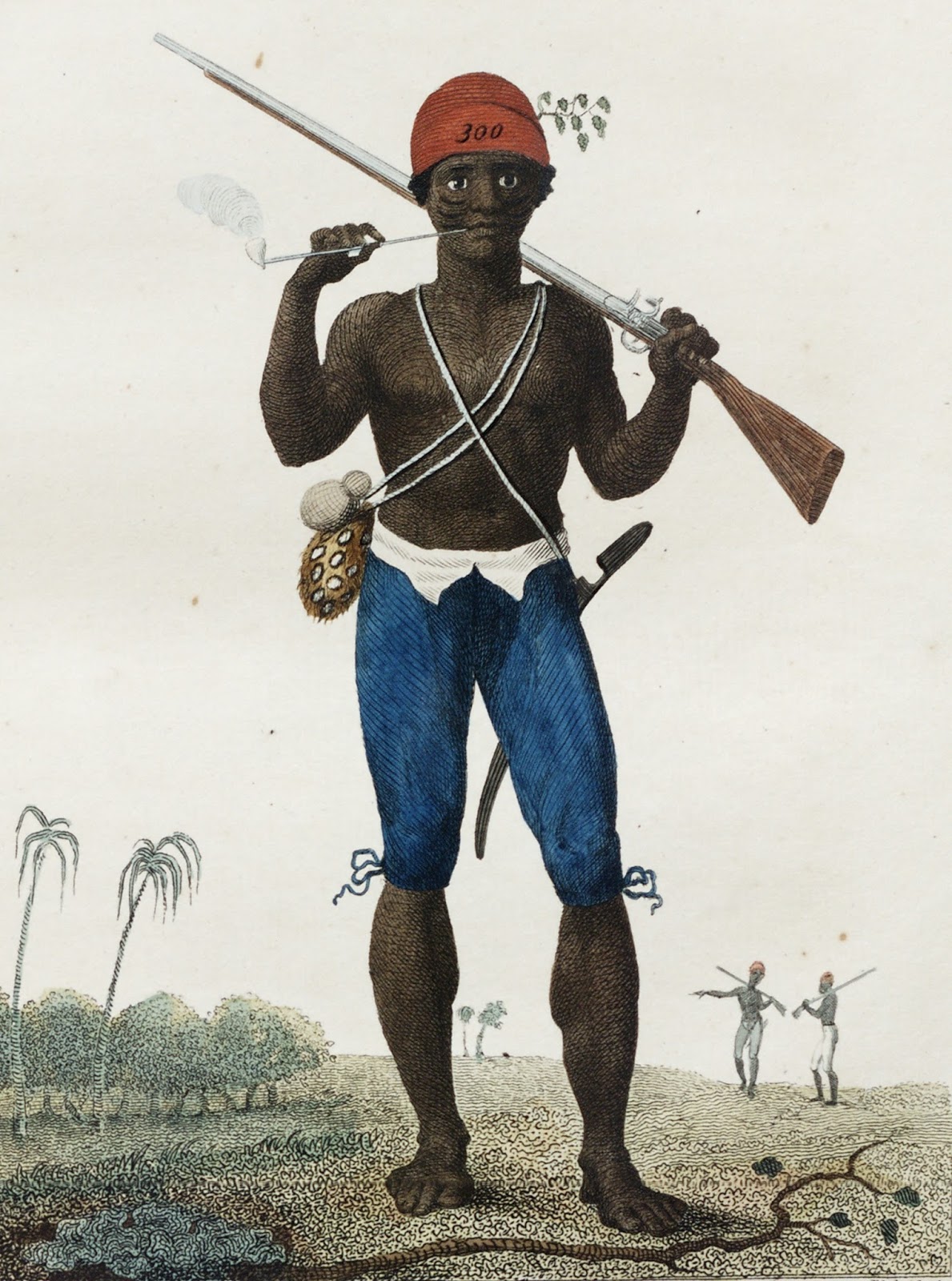
The James Ford Bell Library is fortunate to have Stedman's diaries, journals, letters, and five of his original watercolors, as well as his own copy of his handwritten manuscript produced prior to publication. We have digitized all of this material; it is freely available through the University of Minnesota Libraries' UMedia Archive: Stedman Archive. Anyone visiting the Bell Library in person also is welcome to view and use these materials for research.
The James Ford Bell Library has extensive resources in the slave trade between Europe and the Caribbean and South America, with lesser holdings related to slavery in North America prior to 1800CE.
Subscribe to:
Posts (Atom)